|
Ronald Mak
Department of Computer Science
|
||||||||
|
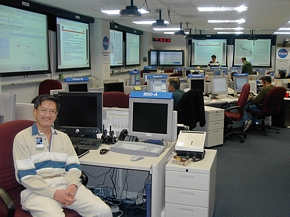
Mission Control, Jet Propulsion Laboratory (JPL) NASA Mars Exploration Rover Mission |
[HOME]
| Guest Lecturer | Possible Topics |
|---|---|
| Allan Acorn | Co-founder of Atari, creator of Pong, developed the MPEG standard and Apple Quicktime; the early history of video games |
| Dennis Allison | The People's Computer Company and the early history of personal computing |
| Gordon Bell |
Digital Equipment Corporation (DEC) Computer Structures textbook |
| Don Chamberlin |
Co-inventor of SQL, System R, and XQuery Evolution of information storage and database systems |
| Edward Feigenbaum | History of artificial intelligence (AI) |
| Robert Garner | RISC architectures and Sun SPARC; Xerox Star |
| Shomit Ghose | Contributions of venture capital to Silicon Valley |
| James Gosling | Java programming language |
| Dan Greiner | Systems architecture from the IBM System/360 to the IBM System Z |
| Alan Kay | Object-oriented programming, graphical user interfaces, Dynabook |
| Stephen Kwan | Information technology (IT), business data processing, service science |
| Ike Nassi | SAP (global enterprise software company) |
| Randall Neff | Early Hewlett-Packard calculators |
| Robert "Bob" Patrick |
Mainframe systems software, systems analysis Taxonomy of application systems |
| David Pease | Instructor of the History of Computing class at U.C. Santa Cruz |
| Mark Seaman |
Naval Tactical Data System (NTDS), UNIVAC CP-642B CMS-2Q programming language (U.S. Navy) |
| Steve "Woz" Wozniak | Co-founder of Apple Computer |
| Project Advisor | Possible Topics |
|---|---|
| Michael Albaugh | IBM 1401, 1440, 1620, 1130; CDC 6600; UNIVAC SS 90; Atari |
| Dennis Allison | (see Guest Lecturer table above) |
| Gordon Bell | (see Guest Lecturer table above) |
| Grady Booch |
Unified Modeling Language (UML) Software engineering tools and methodologies |
| Peter Capek |
Evolution of hardware sytems and software applications Evolution and standards of floating point, storage, I/O control systems, virtual machines, programming languages |
| Ward Cunningham | Techniques for displaying old computer programs in the most comprehensible way on the Web |
| Rick Dill | Active for 50 years in computer technology and management from processes to chips to displays to computer applications |
| John Dobyns | Management, economics, methods, etc. of software product development |
| James Gosling | (see Guest Lecturer table above) |
| Randall Hansen | Techniques for displaying old computer programs in the most comprehensible way on the Web |
| Alan Kay | (see Guest Lecturer table above) |
| Christophe Lecuyer |
Zilog Semiconductor technology |
| David Macklin | IBM CPC, 650 RAMAC and SOAP, 1401, APL, FORTRAN |
| Jud McCarthy | IBM PC & PC-XT |
| Robert "Bob" Patrick | (see Guest Lecturer table above) |
| Bernard Peuto |
History of Zilog History of computing at Rice University |
| John Pokoski | Comparisons of computer architectures; machine instructions for variable-length data |
| Ken Ross | Computer timesharing |
| Oscar Salmassy | Experiences from the IBM 2311 Direct Access Storage Facility for the IBM System/360 to microprocessor development for the IBM ATM attachment |
| Dick Sites | DEC Alpha, IBM Stretch, Burroughs B6700 |
| Van Snyder |
FORTRAN and scientific computing IBM 1401 Autocoder |
| Jim Warren |
West Coast Computer Faire Intelligent Machines Journal (IMJ) Dr. Dobb's Journal of Computer Calisthenics & Orthodontia Computer privacy and freedom |
There will be an unofficial field trip to the museum on Saturday, August 27, starting at 10:30 AM with free passes for students enrolled in this classs. Besides a self-guided tour of the exhibits, you can see a live demo of the Babbage Difference Engine and experience a fully restored 50-years-old IBM 1401 computer system in operation. (Of course, you can always visit the museum on your own anytime it's normally open to view the exhibits or to conduct research.)
Besides the Computer History Museum, you will have access to other historical repositories, many of which are on the Web.
You will work in small project teams to research the history of computing. Based on the team members' interests and with the instructor's consent, each team will devise a project that investigates some historic hardware or software artifact or methodology, a legendary computing pioneer or company, or the evolving impact of computing on work and society. All projects will rely on original sources.
Example projects include
Each project team will present oral progress reports of its activities during the semester to the rest of the class. Final deliverables will be research results that can be submitted to the Computer History Museum or posted to websites devoted to computing history such as the IEEE Global History Network described above.
|
|||||||||
|
A History of Modern Computing, 2nd edition Paul E. Ceruzzi The MIT Press, 2003 ISBN: 978-0262532037 |
I've written books on compiler writing, software engineering, and numerical computation. I find designing and developing software such as compilers and enterprise systems to be fun and challenging. So I'm the kind of geek nobody wants to talk to at parties. My one redeeming feature is that I have two cute cats.