


Local Storage, Tasks
CS185c
Chris Pollett
Mar 5, 2012
CS185c
Chris Pollett
Mar 5, 2012
<html>
<head>
<title>Local Storage Test</title>
</head>
<body>
<script type="text/javascript">
    if (localStorage) {
        document.write("<h1>Local Storage is Working!</h1>");
        testStorage();
    } else {
        document.write("<h1>Local Storage is Unavailable!</h1>");
    }

    function testStorage()
    {
        myvalue = localStorage.getItem("mykey1");
        myvalue2 = localStorage["mykey2"];

        if(myvalue) {
            document.write("<p>Found stored value for mykey1 ="+
                myvalue+"</p>");
            localStorage.removeItem("mykey1");
            //can use localStorage.clear();  to get rid of everything
        } else {
            localStorage.setItem("mykey1", "hello");
        }
        if(myvalue2) {
            document.write("<p>Found stored value for mykey2 ="+
                myvalue2+"</p>");
        } else {
            localStorage["mykey2"] = "yo";
        }

        document.write("<h1>List all that's stored after update</h1>");
        for (i=0; i<=localStorage.length-1; i++)
        {
            key = localStorage.key(i);
            value = localStorage.getItem(key);
            document.write("<p>("+key+", "+value+")</p>");
        }
    }
</script>
</body>
</html>
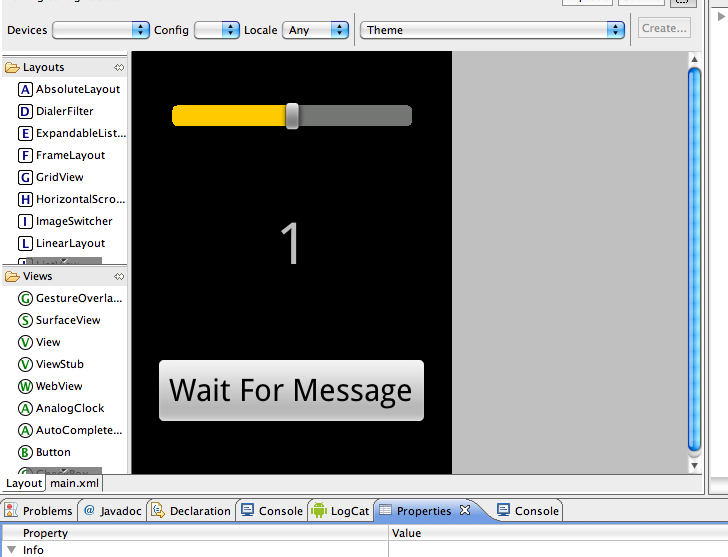
package org.pollett.TimerTest;

import org.pollett.TimerTest.R;

import android.app.Activity;
import android.app.AlertDialog;
import android.content.Context;
import android.content.DialogInterface;
import android.os.Bundle;
import android.widget.SeekBar;
import android.widget.TextView;
import android.widget.SeekBar.OnSeekBarChangeListener;
import android.widget.Button;
import android.view.View;
import android.view.View.OnClickListener;
import android.os.Handler;


public class TimerTest extends Activity {
    Handler handler = new Handler(); //used to set up a delayed callback
    SeekBar seekBar; //object associated with SeekBar on our Layour
    TextView progressLabel; //object associated with our TextView label
    AlertDialog alertDialog; //object used to hold our Alert

    //Runnable object called after delay via Handler
    Runnable alertTask = new Runnable() {
        public void run() {
            alertDialog.show();
        }
    };


    /**
        Called when the activity is first created.
        Sets up all our the event listeners used in our example
    */
    @Override
    public void onCreate(Bundle savedInstanceState) {
        super.onCreate(savedInstanceState);
        setContentView(R.layout.main);

        //set up the seekBar events to modify the label value
        progressLabel  = (TextView)this.findViewById(R.id.TextView01);
        seekBar = (SeekBar)this.findViewById(R.id.SeekBar01);

        seekBar.setOnSeekBarChangeListener(new OnSeekBarChangeListener() {
			public void onProgressChanged(SeekBar seekBar, int progress,
					boolean fromUser) {
            	progressLabel.setText(""+progress);

			}
        	public void onStartTrackingTouch(SeekBar seekBar) {
        		//we're not doing anything here
			}

			public void onStopTrackingTouch(SeekBar seekBar) {
        		//we're not doing anything here
			}


        });

        //set up our Alert Dialog but don't display it yet
        AlertDialog.Builder builder = new AlertDialog.Builder(this);
        builder.setMessage("You've waited long enough!").setCancelable(true);
        alertDialog = builder.create();
        alertDialog.setButton("OK", new DialogInterface.OnClickListener() {
            public void onClick(DialogInterface dialog, int which) {
                return;
        } });

        // set up button, when button is clicked, use handler to schedule a task
        Button waitButton = (Button)this.findViewById(R.id.Button01);
        waitButton.setOnClickListener(new OnClickListener() {
            public void onClick(View v) {
                handler.removeCallbacks(alertTask);
                handler.postDelayed(alertTask, seekBar.getProgress()*1000);
	    }
        });
    }
}
Which of the following is true?
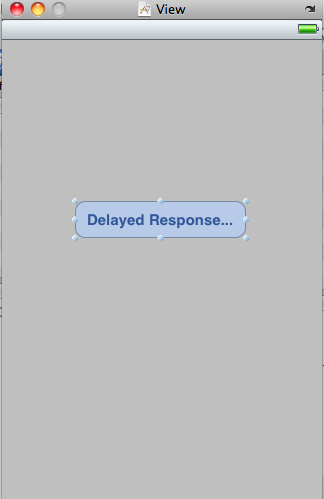
@interface NSTimerDemoViewController : UIViewController {
	NSTimer *timer;
}
-(void) delayedResponse:(NSTimer*)theTimer;
-(IBAction) buttonPressed: (id) sender;
@end
-(IBAction) buttonPressed:(id) sender
{
	timer = [NSTimer scheduledTimerWithTimeInterval: 5.0 target:self
		selector:@selector(delayedResponse:) userInfo:nil repeats:NO];


}

-(void) delayedResponse:(NSTimer*)theTimer {
	UIAlertView *alert = [[UIAlertView alloc]
            initWithTitle:@"Button Pressed -- Took A while"
	    message:@"You pressed the button, but I was napping"
	    delegate:nil
	    cancelButtonTitle:@"Yep, I did"
	    otherButtonTitles:nil];
	[alert show];
	[alert release];
}
After writing the above code, we connect the button up to buttonPressed in interface builder and the program should work.
setTimeout(myCallback, repeatTimeInMilliSec);
// myCallback is the Javascript function you would like called
@class SwitchViewController;

@interface AppDelegate : UIResponder <UIApplicationDelegate>

@property (strong, nonatomic) UIWindow *window;
@property (strong, nonatomic) SwitchViewController * switchViewController;

@end
#import "AppDelegate.h"
#import "SwitchViewController.h"
@implementation AppDelegate

@synthesize window = _window;
@synthesize switchViewController;

- (BOOL)application:(UIApplication *)application didFinishLaunchingWithOptions:(NSDictionary *)launchOptions
{
    self.window = [[UIWindow alloc] initWithFrame:[[UIScreen mainScreen] bounds]];
    // Override point for customization after application launch.
    self.switchViewController = [[SwitchViewController alloc] initWithNibName:@"SwitchView" bundle:nil];
    UIView *switchView = self.switchViewController.view;
    CGRect switchViewFrame = switchView.frame;
    switchViewFrame.origin.y += [UIApplication sharedApplication].statusBarFrame.size.height;
    switchView.frame = switchViewFrame;
    [self.window addSubview:switchView];
    self.window.backgroundColor = [UIColor whiteColor];
    [self.window makeKeyAndVisible];
    return YES;
}
#import <UIKit/UIKit.h>

@class BlueViewController; //similar to declaring something external in C
@class YellowViewController;

@interface SwitchViewController : UIViewController
@property (strong, nonatomic) YellowViewController *yellowViewController;
@property (strong, nonatomic) BlueViewController *blueViewController;

-(IBAction) switchViews:(id) sender;

@end