
A Student Information System
System Architecture
presented by
J. Pearce
Cyberdelic Designs, Inc.
for
San Jose State University
Introduction
The intended audience of an architectural document are system developers. The architectural document describes the internal structure of the system, while the specification describes the external features. The architectural document should make a point of relating itself to the specification.
System Structure and Behavior
Subsystems
This section describes packages and their dependencies. Use a diagram to give an overview, then follow up with textual descriptions of each package and dependency.
Collaborations
Include a subsection for each package.
Presentation and Control
A collaboration is a collection of objects that work together to realize one or more use cases. A collaboration section consists of three parts: a mention of the use cases it realizes, a class diagram (structure), and one or more interaction diagrams (behavior). The same class/object may appear in many collaborations.
View Transcripts
The presentation and control use cases allow students to view their transcripts and the schedule of classes.
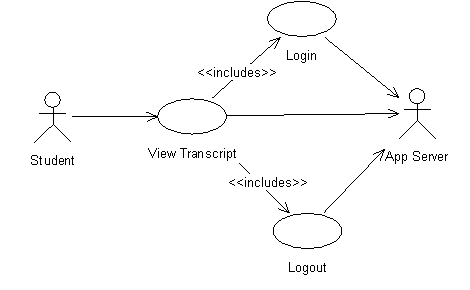
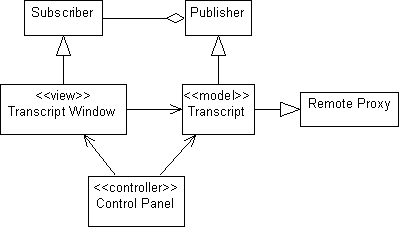
This use case will be realized by a collaboration that uses the Model-View-Controller design pattern refined by the Publisher-Subscriber pattern and the Remote Proxy pattern. The model is a remote proxy that connects to the application server:
A collaboration also includes collaboration and/or sequence diagrams showing the flow of control:

Application Server
Data Manager
Deployment Model
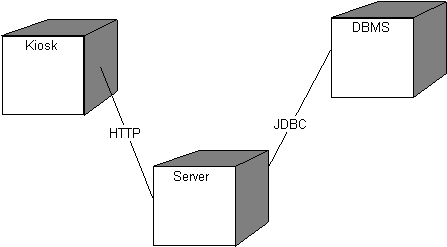
The deployment model shows nodes, links, and protocols:
Glossary
Architecture documents need a glossary, too. Usually this extends the glossary from the specification document.