Spontaneous synchronization is a more mysterious form of emergent behavior in which the cyclical behavior of a system's components or agents tend to align with each other.
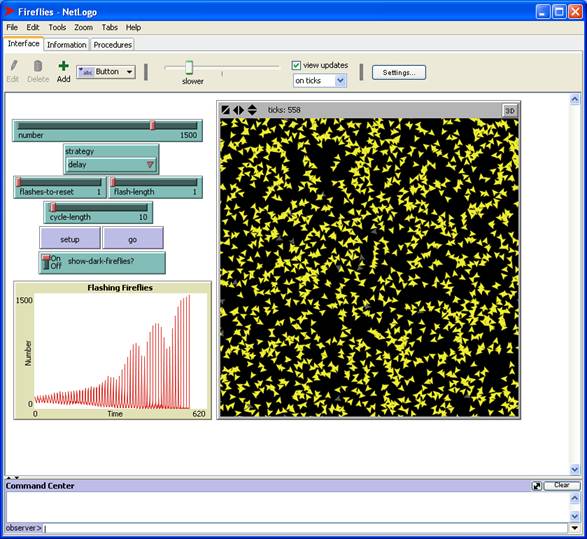
Certain types of fireflies will synchronize their flashing. In this simulation each firefly (turtle) has a cyclical clock. During a certain period the firefly flashes yellow, otherwise it turns dull gray. Initially, the clocks aren't synchronized, so neither is the flashing.
During a brief period in the dark part of the clock's cycle, the firefly counts the number of flashing neighbors. If it is above some threshold, the firefly will reset its clock to some fixed point in the cycle.
Here's another interesting link:
http://home.clara.net/heureka/books/synchronicity.htm
Ants aren't very smart, yet a colony of ants will exploit food sources in order of their distance from the colony. In other words, we could use a colony of ants to sort a list of numbers.
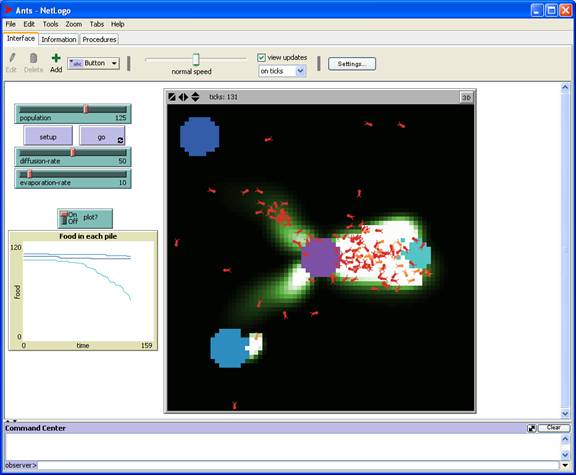
In the Ants model ants (turtles) wander around randomly. If one finds a piece of food, he brings it back to the ant hill, leaving a chemical trail as he goes. The chemical has a diffusion rate (the width of the trail) and evaporation rate (how long the trail lasts). Both of these can be controlled by the user.
If a wandering ant comes across a chemical trail, he follows it to its source. If he finds food, he brings it back to the ant hill and reinforces the chemical trail.
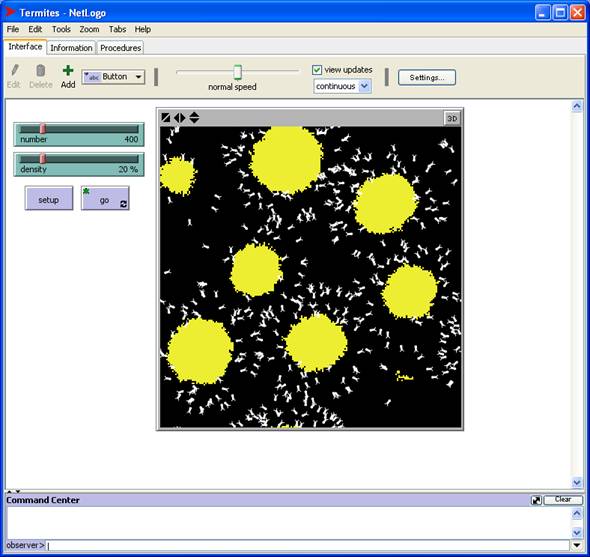
Termites provide us with an excellent example of emergent behavior: stacking woodchips. How do they do it? Actually, it's pretty simple. Each termite roams around randomly until it finds a woodchip. It picks up the chip and resumes random roaming until it finds another woodchip. It then drops the woodchip it is carrying and goes off to look for another woodchip. Pretty soon, we have piles: