|
Joint Biology and Computer Science Track in Bioinformatics
Bioinformatics is an emerging discipline that integrates molecuar biology, genetics,
biochemistry and computer science. It provides tools that allow scientists to make
use of the vast amount of biological data generated in recent years and to answer
questions unimaginable just a decade ago. Bioinformatics has revolutionized gene
discovery and analysis, and offers excellent career opportunities for those who
master it.
Link to
companies and institutions in the Bay Area.
The departments of
Biological Sciences and
Computer Science at
San Jose State University designed a new BSCS Track in
Bioinformatics.
|
Recommended Prerequisite for
CS Majors
Molecular Biology for Computer Scientists
Biology 23
Not offered in Fall 2009
The aim of this course is to help computer science students become familiar with the
principles of molecular biology as they relate to bioinformatics. The emphasis will be
on the molecular workings of a cell, including the fundamental processes by which coded
genetic information is decoded during the production of useful macromolecular structures
and machines.
Prerequisites: CS 46A; No college biology required.
|
|
|
Required Courses
Bio/CS 123A
Offered in Fall 2009
Tuesdays and Thursdays from 9:00 to 10:15 in MH450.
Instructor: Dr. Sami Khuri
This practical course, cross-listed with the biology department,
provides an introduction to the main public domain tools, databases
and methods in bioinformatics, including DNA and protein databases, such as Genbank and
PDB, software tools such as BLAST, FASTA, Smith-Waterman; and methods including those
for aligning sequences.
More precisely, the course analyzes the algorithms behind the most successful tools, such as the
local and global sequence alignment packages mentioned above;
and the underlying methods used in fragment assembly packages.
This course is intended both for biology and computer science
students, to work together to solve complex biological questions requiring
modification of standard code.
Prerequisites: Interest in Biology for CS majors.
Bio/CS 123B
Offered in Spring 2010.
Instructor: Dr. Sami Khuri
This practical course, cross-listed with biology, continues to cover
the computational methods used for searching, classifying, analyzing, and modeling protein
sequences. The course also continues to cover tools for analyzing DNA and RNA sequences.
More advance topics, such as genetic algorithms and simulated annealing
which can be used to address folding problems, are covered.
Prerequisites: Bio/CS 123A or instructor approval.
|
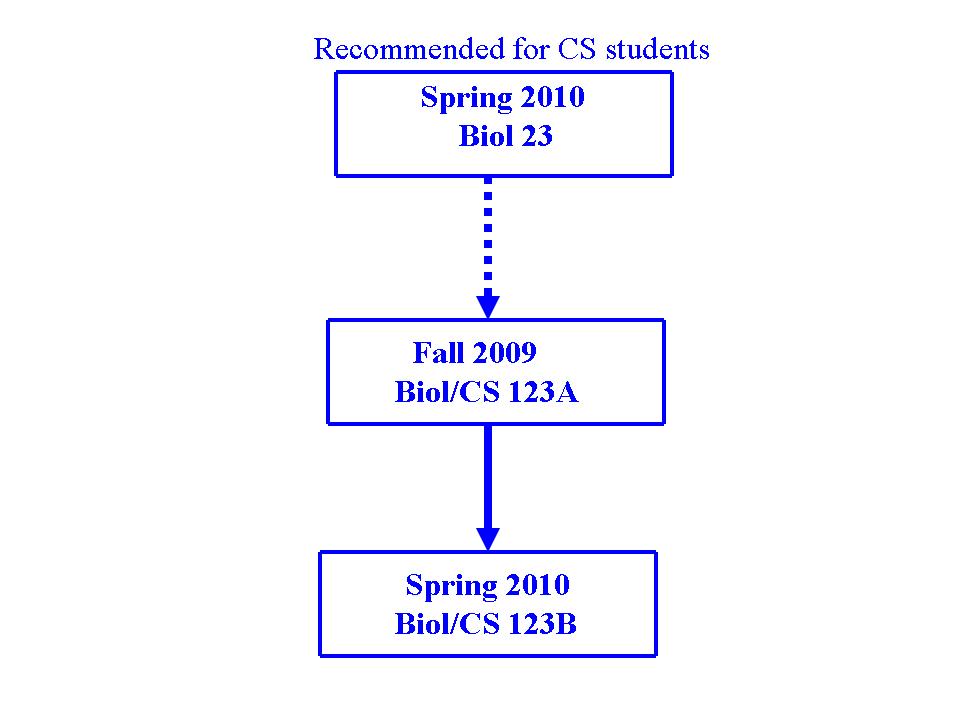
Overview of the program
|
Additional Courses of Interest
Advanced Programming with PERL
CS 122
Offered in Spring 2010
Instructor:
Natasha Khuri
This course introduces the Perl programming language with an emphasis on
data manipulation, file processing and database access. The course will
deal with real life applications in various fields such as system
administration, networking and bioinformatics.
Prerequisites:
CS146 or by permission of the instructor.
Statistics for Bioinformatics
Math 162
Not offered in Fall 2009
Instructor: Dr.
Martina Bremer
Introduction to data analysis methods which are widely used in
bioinformatics.
Methods deal with prediction, classification, optimization, and
clustering. The
methods are placed into the context of principles and models of
statistical science,
with emphasis on Bayesian methods.
Prerequisite: Math 161A or instructor
consent.
|
|